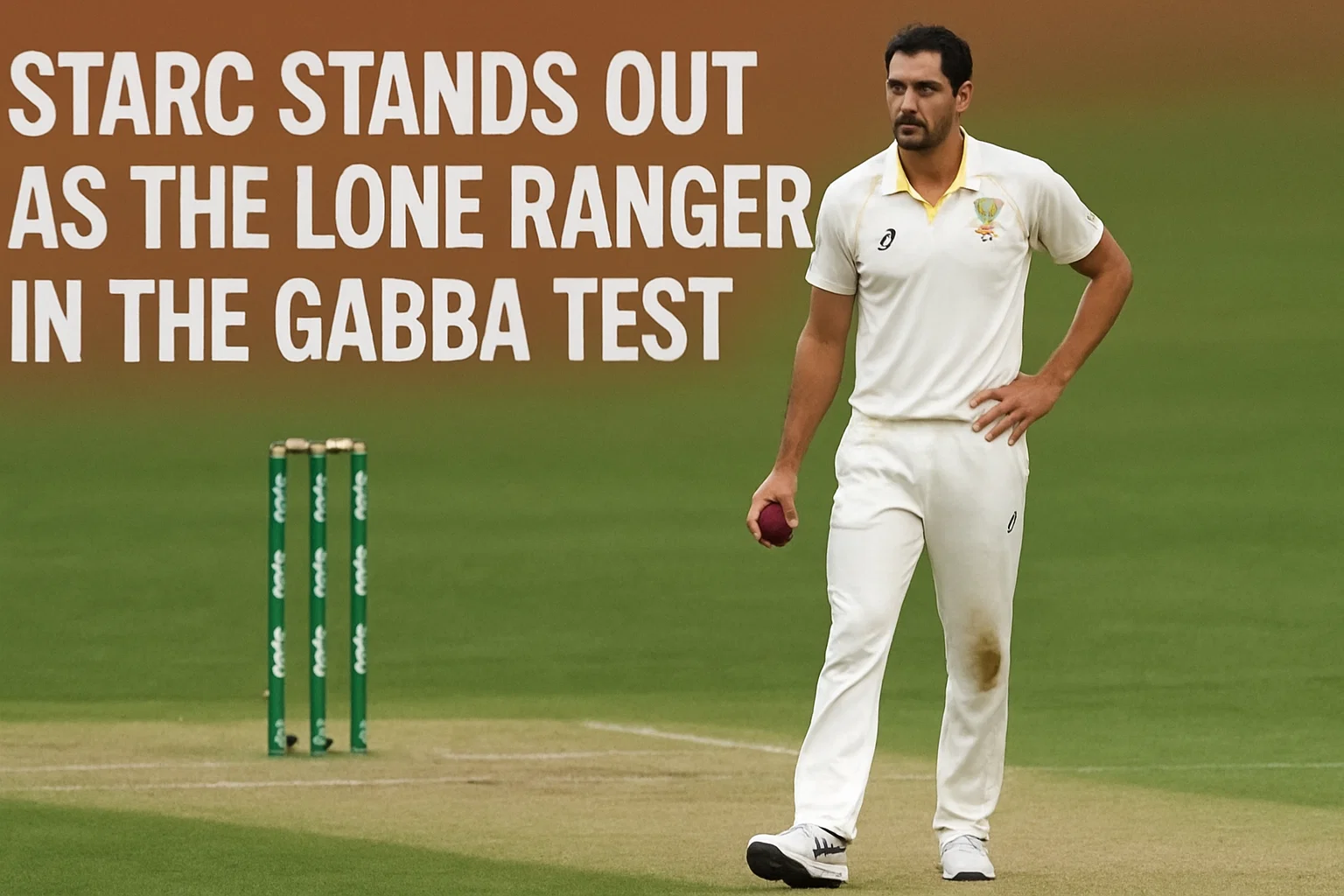
Mitchell Starc has always been known as one of Australia’s most destructive fast bowlers, but the opening day of the Ashes Test at the Gabba added a new chapter to his legacy. Playing without his long-time partners Pat Cummins, Josh Hazlewood and Nathan Lyon, Starc found himself as the lone survivor of Australia’s famous “awesome foursome.” Yet, instead of struggling, he rose to the moment, grabbing an outstanding 6 for 71 and reminding the world of his unmatched ability when the pressure is at its highest.
This match was only the second time in his career that played a Test without the other three senior bowlers. Australia entered the game missing a combined total of 1166 Test wickets, with Cummins very close to playing, Hazlewood ruled out, and Lyon surprisingly dropped. The absence of these three giants raised serious questions: Could Australia’s attack remain threatening? Could Starc carry the entire load alone? Day one proved that he could.
A Rare Moment: Starc Leads the Attack Alone
Australia usually depends on the strong combination of Cummins’ accuracy, Hazlewood’s discipline and Lyon’s consistency. With all three missing, the balance of the attack looked uncertain. It was a situation almost impossible to imagine for an Ashes Test. But Starc stepped forward like a seasoned warrior.
From his very first spell, Starc appeared sharp, energetic and focused. His ability to swing the new ball, mix up his pace, and attack the stumps kept England under pressure throughout the day. While the pitch at the Gabba offered bounce, it was Starc’s control and planning that made the biggest difference.
He struck early, broke partnerships when needed, and returned late in the day to clean up the tail. His 6-wicket haul was not just a statistical highlight; it was a leadership statement.
England Fight Back but Starc Keeps Australia Afloat
England did not make things easy, especially when Zak Crawley and Joe Root stitched together a strong partnership of 117 runs in just 25 overs. Their aggressive approach seemed to frustrate the Australian bowlers, and at times, a change of pace or variation—usually offered by Cummins or Lyon—felt desperately needed.
Later, Root and Ben Stokes continued England’s positive momentum, pushing them to 210 for 4 in the final session. Even in the last-wicket partnership between Root and Jofra Archer, England kept hitting freely. But every time Australia needed a breakthrough, Starc delivered.
These key strikes prevented England from running away with the game. His ability to rise in different situations—new ball, middle overs, or reverse swing—proved why he is still one of the world’s most dangerous Test bowlers.
A Decision to Judge in Hindsight
Australia’s decision to drop Lyon and go with a different attack will be debated. Some moments clearly showed that a frontline spinner or a second experienced quick would have helped. But judging by Starc’s performance, Australia did not lose their cutting edge.
Starc showed that experience, confidence, and hunger can sometimes outweigh numbers. While the other bowlers struggled to find rhythm, he carried the responsibility with pride and passion.
Starc’s Performance Shows Why He Is Irreplaceable
For years, debates have surrounded spot in the XI—questions about form, consistency, or economy often come up. But performances like this remind critics why Australia keeps backing him. His wicket-taking ability is unmatched, especially in home conditions.
He is unique because he can produce unplayable deliveries out of nowhere. His full swinging yorker, his sharp bouncer, and his unpredictable angle from left-arm over make him a nightmare for batters.
Key Highlights
| Key Point | Details |
|---|---|
| Focus Bowler | Mitchell Starc |
| Wickets Taken | 6 for 71 |
| Missing Bowlers | Cummins, Hazlewood, Lyon |
| Combined Missing Wickets | 1166 Test wickets |
| Opponent | England |
| Venue | Gabba, Brisbane |
| Key Partnerships | Crawley–Root (117), Root–Stokes (210 for 4) |
| Starc’s Significance | Lone leader of Australia’s attack |
More:- Starc Stands